
Smart Lock Installation in London — Fitting by Door Type
Smart Lock Installation in London — Fitting by Door Type
Almost every smart lock problem in London is a door problem, not a lock problem. The same product that drops straight onto a 1930s timber front door in Walthamstow is the wrong answer on a composite door in a new-build in Croydon, and the wrong answer again on a flat entrance door in a block in Camden. So this page is organised the way the job actually works: find your door type first, then the lock follows.
TaskMan of London is a first-party London company — our own DBS-checked, insured fitters, not a marketplace of strangers. We cover London within the M25 and back every fit with a 12-month workmanship warranty. Every job starts as a text conversation: you send photos of your door and lock, we tell you what will actually fit, and compatibility and cost are settled between us before a date goes in the diary.
That photo step is not a formality. Handle-to-keyhole spacing, whether your cylinder has an escape function, how much room there is around the keyhole, whether your door is a certified fire door and where your router sits relative to the front door all decide the product. We would rather find that out on a photo than on your doorstep.
Brand guides:
Which lock suits your door
The door decides the lock, not the other way round. Find yours below.
uPVC or composite door with a multipoint lock (lift-to-lock)
How to tell: There is a long lever handle on both sides and a euro keyhole — a circle with a slot under it — in line with the handle, usually below it. To lock, you push the door to, lift the handle up until it stops, then turn the key, and you can hear several hooks, rollers or bolts shoot into the frame up and down the door edge. Open the door and look at the long metal strip on the closing edge: you will see a latch, a deadbolt and two or more hooks or mushroom cams. Typical of anything built or re-doored from roughly the 1990s onwards, including most London new-builds and back doors. Two things to note for us while you are there: stand outside and see whether the door swings towards you or away from you (inward or outward opening changes which products and clearances apply), and if the hooks shoot out when you turn the key even though you never lifted the handle, that is a key-operated multipoint — still this door type, but tell us, because it behaves differently.
What fits: Two genuinely different routes. Route one replaces the handle furniture. The Yale Conexis L2 is the mainstream UK product for this door: Yale list it for UK uPVC and composite doors with handle and multipoint locks, stated for most inward-opening lift-to-lock doors, 92mm handle-to-cylinder centres and a 44–70mm door thickness. Ultion Nuki and Ultion Nuki Go sit in the same family — an Ultion 3 Star PLUS cylinder with a Nuki motor, sold specifically for British PVC and composite doors, using the fixing holes already in your door to replace common UK push-down handles, at 92mm from handle spindle centre to keyhole centre, with handle fixing centres of 215mm, 211mm and 122mm accommodated and an escutcheon version in the box for doors with a long handle rather than a lever. Ultion also sell a matching external handle in a range of finishes. The important difference from the Conexis: Ultion state the lock can always be operated manually with a physical high-security key or the internal thumbturn, so the outside key survives. Route two motorises the cylinder and leaves the handle furniture alone: a Nuki Smart Lock Go or Smart Lock Pro (5th generation) on your existing cylinder, a Nuki Smart Lock Ultra (which brings its own integrated Universal Cylinder and therefore needs the cylinder changed), or a Yale Linus Smart Lock L2 or L2 Lite. SwitchBot state their Lock Ultra and Lock Pro work with multipoint locks and with however many rotations the lock needs; for the Lock Pro, SwitchBot state compatibility with locks whose locking and unlocking rotation is 10 degrees or more.
What fitting involves: Route one, Conexis L2: both handles come off, the existing euro cylinder comes out and is replaced by Yale's own cylinder, which carries a spindle on the inside only and is blank on the outside — so afterwards that lock has no external keyhole at all. You lock by lifting the handle as normal and the lock deadlocks; you unlock by phone, key tag or card, with an internal thumbturn inside. Route one, Ultion Nuki: the handle furniture is swapped using the existing fixing holes and the cylinder becomes the Ultion, with the motor on the inside — the multipoint gearbox, hooks and keeps stay as they are, you lift the handle as normal, and your key still works from outside. Either way this is a permanent change to the door's hardware, which matters if you rent. Route two, cylinder motor: handles, gearbox and hooks are all retained; the cylinder is either kept or swapped for one correctly sized with a thumbturn and an emergency function, and the motor clamps to the inside thumbturn. The honest limitation is that a motor can turn a cylinder but cannot lift a handle — it will withdraw the hooks and let you in, but the door only truly deadlocks once somebody lifts the handle. If you want auto-lock behaviour on a lift-to-lock door, say so early, because it changes which route we recommend.
Door with a euro cylinder and one central locking point
How to tell: One euro keyhole, and turning the key once throws a single bolt — no handle lift, no row of hooks on the door edge. Very often there is a thumbturn, a small knob you twist, on the inside where the second keyhole would be. Common on timber and aluminium front doors, flat entrance doors, side and garden doors, and on communal-side doors within converted houses. One check before you decide this is you: if hooks or rollers shoot out when you turn the key even though you did not lift the handle, you still have a multipoint — treat it as the door type above and tell us. Also note whether the door opens towards you or away from you as you stand outside, because the clearance the motor needs is different on an outward-opening door.
What fits: This is the widest choice, because the whole retrofit category was built for it. Nuki Smart Lock Go and Nuki Smart Lock Pro (5th generation) are stated by Nuki as compatible with existing key-and-knob cylinders. Nuki Smart Lock Ultra is the exception in that range: it comes with an integrated Universal Cylinder and requires a cylinder change, with Nordics and Swiss variants for non-euro profiles. Yale Linus Smart Lock L2 has Wi-Fi built in, and Linus Smart Lock L2 Lite is Bluetooth and Matter — with the L2 Lite, remote access comes either through a Thread border router and a Matter controller such as Apple Home, Google Home or SmartThings, or through Yale's ConnectX bridge if you want it in the Yale Home app. Both fit over an existing euro cylinder where compatible, with Yale's own Linus Adjustable Cylinder as the fix when the existing cylinder lacks an emergency function. Aqara Smart Lock U200 adds an outside keypad with fingerprint, PIN, NFC and Apple home key and states support for euro mortise locks with the emergency function; the U200 Lite is the interior-only version, Matter over Thread, working with Apple Home, Google Home, Alexa, SmartThings and Home Assistant, with an Aqara Adjustable Cylinder available. SwitchBot Lock Ultra and Lock Pro also mount on the inside thumbturn and handle horizontal and vertical keyways, with SwitchBot stating Lock Pro compatibility down to a 10-degree locking rotation. Nuki's Keypad, Keypad 2 and Keypad 2 NFC, Fob and Door Sensor add PIN, fingerprint or NFC entry outside without touching the lock case.
What fitting involves: In the best case nothing on the outside of the door changes and nothing is drilled: the motor body mounts on the inside over the thumbturn, on a clamp or plate, and your existing key still works from outside. In practice the cylinder is often changed anyway — because it has no emergency function, meaning nobody could key it from outside while the motor sits engaged on the inside; because the thumbturn does not protrude far enough for the motor to grip; or because it is the wrong length and stands proud of the escutcheon, which is the classic snapping weakness. Where an outside keypad is part of the plan, as with the Aqara U200, an exterior unit is fitted too and the two halves are aligned through the cylinder. The lock case and keeps in the door are untouched throughout.
Timber door with a nightlatch or rim lock (the classic 'Yale lock')
How to tell: Look at the inside face of the door near the closing edge: a metal box sits on the surface of the door, with a small lever or snib you can flick across to hold the latch back. Outside there is a round keyhole set into the face of the door, usually above the handle or letterplate. Very often there is a second, separate lock lower down taking a long thin key — that is a mortice deadlock, a different lock doing a different job. Standard on Victorian and Edwardian London front doors and on flat doors in older conversions. The measurement that decides everything here is the backset: from the closing edge of the door to the centre of that round keyhole, usually 60mm or 70mm. Measure it and send the number.
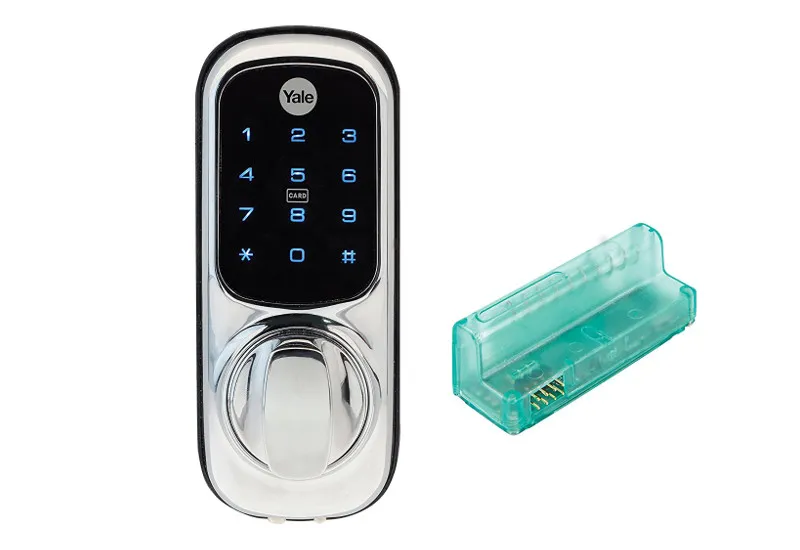
What fits: The Yale Keyless Connected is the mainstream current UK option: Yale list it for wooden doors with a nightlatch, replacing the existing rim cylinder and driving the same latch, opening by PIN code, key card, key tag or remote fob, with a Yale Connect module added for app and remote control, and available in several finishes. It is designed around 60mm backset nightlatches — Yale's UK material states 60mm — so anything else needs the nightlatch checked and very possibly changed first. Door thickness matters here too, and published figures for this lock vary, so we confirm your measurement against Yale's current specification rather than guessing. SwitchBot publish a night-latch mode for the EU version of Lock Ultra, with their own setup guidance for it; we treat that as promising rather than proven on a British rim nightlatch and would confirm it on your specific lock before recommending it. Where a nightlatch simply cannot take a smart unit, the usual alternative is to keep the nightlatch mechanical and put a retrofit smart lock on the euro-cylinder mortice lock if the door has one.
What fitting involves: The rim cylinder — the round barrel visible from outside — is removed and the keypad unit takes its place, driving the same nightlatch through a connecting bar cut to length for your door thickness. The nightlatch case inside is retained if its backset and pattern are compatible; where it is not, the nightlatch is replaced first and that becomes part of the job. Two things surprise people. That lock no longer has an external keyhole, so entry from outside is by PIN, card or tag; the Keyless Connected does carry a 9V battery backup override for a flat-battery emergency. And any separate mortice deadlock stays fully mechanical and still needs its own key — which is usually exactly what your insurer wants. This is a permanent change to the door's hardware, so it is not the route for most renters.
Flat entrance door inside a block (almost always a fire door)
How to tell: A heavy, solid-feeling door with a self-closer at the top, and a groove around the edge of the door or frame holding intumescent strips and brush-type smoke seals. There may be a small certification label or plug on the hinge or top edge. The lock itself is usually a euro cylinder in either a single-point or multipoint case, often with a thumbturn inside so you can get out without a key.
What fits: Whichever of the above matches your actual lock — but with a strong preference for interior-only retrofits (Nuki Smart Lock Go or Pro, Yale Linus L2 or L2 Lite, Aqara U200 Lite, SwitchBot Lock Ultra or Lock Pro) precisely because they add no new holes to the door leaf and can be taken off again leaving the door as it was. Handle-replacement products such as the Conexis L2 and Ultion Nuki, and rim keypads, can still be the right answer technically, but they are a permanent hardware change and become a conversation with your freeholder or managing agent first, not a same-day decision.
What fitting involves: On the retrofit route: no drilling of the door leaf, existing lock case and hinges untouched, cylinder changed only if it must be, and the escape function preserved so anyone inside can always get out without a key or a phone. Anything that means new holes, a new lock case, a different faceplate or removing the closer changes the door's fire performance, and TaskMan of London will not do that off our own bat — we will tell you so on the photos, before you book, rather than on the day.
Communal or building entrance door
How to tell: The shared street door into the block. There is an intercom panel outside with buttons or a fob reader, an electric release or magnetic lock in the frame, and a heavy closer. You get in with a fob or by being buzzed in from a flat, and there is usually a handset or video panel on the wall inside your flat.
What fits: Not a consumer smart lock. This door belongs to the freeholder or managing agent and is normally part of a managed access control and fire strategy. What we can usually do instead is fit a Nuki Opener inside your own flat, wired to your existing intercom handset, so you can release the street door from your phone or let a cleaner or a delivery in. Nuki's own guidance covers analogue and many digital intercoms, with a generic analogue profile for unlisted systems, within a stated limit of 50V AC/DC and 2A. Nothing about the communal door itself is altered.
What fitting involves: The Opener mounts beside or behind your intercom handset in your hallway and takes over the door-release button electrically. Your handset carries on working normally. It needs a wired intercom handset — app-only or IP video entry systems, and blocks where the entry system is centrally managed, may not allow it. Anything on the communal door leaf, the reader, the mag-lock or the entry panel is a managing agent job and we will say so rather than take it on.
What the job actually involves
- A motor can turn a cylinder; it cannot lift a handle. On a lift-to-lock uPVC or composite door, a retrofit motor on the cylinder will withdraw the hooks and let you in, but the door is only properly deadlocked once somebody physically lifts the handle. Any 'auto-lock when I leave' expectation on that door type has to be checked against this before you choose a product — it is the single most common disappointment we see.
- The emergency function decides whether a retrofit is even possible. A retrofit motor sits on the inside thumbturn, which leaves the cylinder permanently engaged from inside. If the cylinder has no emergency (escape) function, nobody can then key it from outside. Every serious manufacturer sells a replacement cylinder for exactly this reason — Yale's Linus Adjustable Cylinder, Nuki's Universal Cylinder, Aqara's Adjustable Cylinder, or an Ultion. We would rather bring the right cylinder than discover it at your door.
- Cylinder length is measured from the centre fixing screw outwards, as two separate halves, inside and outside. Guessing it is how people end up with a cylinder standing proud of the escutcheon, which is precisely what gets attacked by snapping. Getting a smart lock fitted is the natural moment to correct a proud or under-length cylinder, and on a uPVC or composite door that usually means moving to a TS007 3-star rated cylinder at the same time.
- There has to be physical room around the keyhole for the motor body, and it depends on which way your door opens. Nuki specify more than 30mm from the keyhole centre to both the frame and the handle on an inward-opening door, and more than 40mm to the frame on an outward-opening one. Deep handle backplates, ornate escutcheons, security chains, letterplates and glazing beads all eat into that space, and a door that is fine on paper can be impossible in the flesh.
- If the key is stiff in your hand it will be stiff for a small battery motor. Dropped doors that need a lift or a shove before the handle will go up, misaligned keeps, worn gearboxes and dry cylinders all defeat motorised locks and drain batteries fast. We would rather adjust hinges and keeps, and service or replace the cylinder, than bolt a motor onto a lock that is already fighting the frame.
- On a nightlatch conversion the connecting bar between the outside keypad and the nightlatch case is cut to your door's thickness, and the nightlatch has to be a pattern the kit can drive — these products are built around a 60mm backset, so measure from the closing edge to the centre of the round keyhole and send us the number. Where the backset or pattern does not suit, the nightlatch is replaced first. The outside keypad plate is generally larger than the old rim cylinder ring, which usefully covers old screw holes and paint lines — but not always, and a repaint can be part of the picture.
- Handle-replacement locks re-use the existing spindle and handle fixing holes on a uPVC or composite door and are through-bolted rather than screwed into the slab. That includes both the Yale Conexis L2 and the Ultion Nuki, and it is a permanent change to the door's furniture rather than a reversible clip-on — worth knowing if you rent or lease. New holes into a composite slab, and any new holes at all in a certified fire door, are avoided; on a flat entrance door in a block that is a hard line, not a preference.
- Range matters more in London than the spec sheet suggests. Front doors are often at the far end of a hallway, behind a solid Victorian wall or down a lower-ground lobby. Bluetooth-only locks need their bridge within range, Thread devices need a border router, and Wi-Fi locks need a workable signal at the door itself. We ask where your router is while quoting, not afterwards.
- Losing the outside keyhole is a real trade-off, not a detail. The Yale Conexis L2 and the Yale Keyless Connected both leave that lock without an external key: entry is by phone, tag, card or PIN. That is fine for many households and unacceptable to others, particularly where someone will not carry a phone. Both have a flat-battery fallback — an external 9V terminal on the Conexis L2 and a 9V battery backup override on the Keyless Connected — and if you want to keep a working metal key, the Ultion Nuki keeps one, as do all the interior retrofit motors.
- We do not quote battery life figures, and we would be wary of anyone who does off the cuff. Real-world life depends on how heavy the door is, how many turns the lock takes, how well aligned the door is and how often it is used. What we will do is show you the specific low-battery warning and the specific fallback for your lock at handover.
What can stop a fit going ahead
We check these from your photos before booking, so a visit is not wasted:
- The existing euro cylinder has no emergency function, or the thumbturn does not protrude far enough for the motor to grip — and no correctly sized replacement cylinder is on the van because nobody measured it beforehand.
- The multipoint lock is not the plain lift-to-lock type. Auto-engage or auto-locking multipoints that throw their hooks as the door closes, and split-spindle doors where the inside and outside handles behave differently, do not suit every product and can rule out the handle-replacement route entirely. That is our own fitting experience rather than a manufacturer exclusion, which is exactly why we want photos first.
- Door thickness falls outside the product's stated range. Yale quote 44–70mm for the Conexis L2; Yale publish no door-thickness range for the Keyless Connected, so we check that one against Yale's current specification case by case — send us the measurement. Thick composite slabs and thin old flush doors both fall foul of this.
- Handle-to-keyhole centres are not 92mm. Both the Conexis L2 and the Ultion Nuki assume 92mm centres; older doors, French and patio doors and some imported units use other spacings and will not take those products.
- The nightlatch backset or pattern is not one the keypad kit can drive — these are built around 60mm — so the nightlatch itself has to be changed first, which is a different, larger job than the one that was booked.
- There is not enough clearance around the keyhole for the motor body, because of a deep handle backplate, an ornate escutcheon, a door chain, a letterplate, or the frame return sitting too close on an outward-opening door.
- The door is a certified fire door in a block and the work would mean new holes, a new lock case or a different faceplate — and there is no written consent from the freeholder or managing agent.
- The door is the communal entrance to the block. It is not yours to alter, it forms part of the building's fire strategy and access control, and it needs the managing agent rather than a domestic smart lock.
- The door is dropped, binding or misaligned, so the lock needs forcing by hand. Fitting a motor to it would only guarantee failures and flat batteries; the alignment has to be corrected first, which changes the scope of the visit.
- Your home insurance policy specifies a lock standard the proposed change would break — most commonly a BS3621 mortice deadlock on a timber final exit door, or a TS007 3-star cylinder on a uPVC or composite door.
- You rent, or you are a leaseholder, and the landlord or freeholder has not agreed to the change — including where the landlord needs to keep key access. Handle-replacement and rim-keypad products are permanent changes to the door furniture, so they are usually off the table.
- There is no usable Wi-Fi, Thread or bridge position within range of the door, so the remote features you want would not actually work once fitted.
Smart locks in London homes
London's door stock splits sharply, and the split decides the job. Victorian and Edwardian terraces and conversions across Hackney, Camden, Islington, Wandsworth and the inner suburbs mostly have timber front doors with a surface-mounted nightlatch plus a separate mortice deadlock — Yale Keyless Connected territory, with the mortice staying mechanical for insurance, provided the backset measures up. New-builds and re-doored properties across the outer boroughs and the M25 fringe are overwhelmingly uPVC or composite lift-to-lock multipoints, where the choice is between replacing the handle furniture with a Conexis L2 or an Ultion Nuki, or motorising the cylinder with a Nuki, Yale Linus or SwitchBot and accepting that the handle still has to be lifted to deadlock. Flats add a layer suburban jobs do not have: the flat entrance door in a block is almost always an FD30S fire door with intumescent strips, smoke seals and a self-closer, and although the leaseholder often owns the door itself, the freeholder carries the legal duty for how it performs. Most leases require written consent from the freeholder or managing agent before you alter the door, which is why TaskMan of London leads with reversible interior retrofits on flat doors — nothing drilled, escape function preserved, door restorable. The communal street door is never a domestic smart lock job; it belongs to the freeholder and sits inside the building's access control and fire strategy, so the sensible answer for flat dwellers is a Nuki Opener on their own intercom handset instead. Then there are the practical London realities: thick solid walls between the router and the front door, lower-ground and basement flats with poor signal at the entrance, period doors with deep escutcheons, security chains and letterplates crowding the cylinder, and conservation area sensitivity about visible external hardware on a period frontage. TaskMan of London's DBS-checked, insured fitters cover London within the M25, back every fit with a 12-month workmanship warranty, and start every job as a text conversation with your photos, so compatibility and cost are settled before a date is booked.
Before you book
- Photograph the whole inside face of the door, straight on, so the handle, keyhole, any thumbturn, any nightlatch box and any snib are all visible in one shot.
- Photograph the whole outside face of the door as well — we need to see the handle, the keyhole position, the letterplate and any glazing.
- Stand outside and tell us which way the door opens: does it swing towards you, or away from you? Inward and outward opening doors have different clearance requirements and rule different products in or out.
- Open the door and photograph the closing edge, showing the full lock strip: latch, deadbolt, hooks, rollers or mushroom cams, and any brand name stamped on the faceplate.
- Measure and photograph the distance from the centre of the handle spindle to the centre of the keyhole — 92mm is the common UK figure and a lot depends on whether yours matches.
- If you have a nightlatch, measure the backset: from the closing edge of the door to the centre of the round keyhole, usually 60mm or 70mm. This single measurement decides the whole nightlatch route.
- Measure the door thickness at the edge with a tape and send that number.
- Take a close-up of the cylinder or rim cylinder face, including any markings, kitemark or star rating stamped on it.
- Tell us whether you lift the handle before turning the key, or just turn the key — and whether hooks shoot out when you turn the key. That one sentence decides the whole approach on a uPVC or composite door.
- If you have a nightlatch, say whether there is also a second lock lower down taking a long thin key, and photograph that too.
- Say whether the property is a flat in a block, whether the door has a self-closer and seals around the edge, and whether you have asked the freeholder or managing agent.
- If you want the communal street door on your phone, photograph the intercom handset on your wall, including any model name on it.
- Tell us where your router is relative to the front door, and which app ecosystem you actually use — Apple Home, Google Home, Alexa, SmartThings or Home Assistant.
- Say whether anyone in the household must be able to open the door with a metal key, and whether you rent.
Smart Lock Installation in London — Fitting by Door Type — FAQs
Will a smart lock fit my uPVC or composite front door?
Usually, but which one depends on your handle and lock, not on the door's colour. If you lift the handle before turning the key, you have a lift-to-lock multipoint and there are two sensible routes: replace the handle furniture with a Yale Conexis L2 or an Ultion Nuki, or motorise the cylinder with a Nuki, a Yale Linus or a SwitchBot. Send TaskMan of London photos of the inside and outside of the door plus the open door edge by text, tell us which way it opens, and we will tell you which route your door actually takes before anything is booked.
Do I keep my keys?
It depends on the product, and this is worth getting right before you buy anything. Interior retrofit motors that clamp over the inside thumbturn — Nuki Go and Pro, Yale Linus L2 and L2 Lite, SwitchBot Lock Ultra and Lock Pro, Aqara U200 Lite — leave the outside of the door alone and your key keeps working. The Ultion Nuki replaces the handle furniture but Ultion state the lock can always be operated manually with a physical high-security key or the internal thumbturn, so the key survives there too. The Yale Conexis L2 fits a spindle-only cylinder, so that lock has no external keyhole afterwards, and the Yale Keyless Connected replaces the rim cylinder on a nightlatch, so entry there is by PIN, card or tag. Tell us if a metal key is non-negotiable for someone in the household and we will steer you accordingly.
What happens if the batteries die?
Every product has an answer, and they are not the same answer. Retrofit locks that keep your cylinder simply leave you letting yourself in with your key. Yale's Conexis L2 has an external terminal that takes a 9V battery so you can power the lock and open it with your usual credential, and the Yale Keyless Connected has a 9V battery backup override in the same spirit. Locks warn you well in advance through the app and by beeping. We do not publish battery life figures because real-world life depends on your door and your usage, but we show you the specific fallback for your lock at handover — and we will tell you honestly if we think a particular lock's fallback does not suit your household.
Will my home insurance still be valid?
Check your policy wording, because most UK policies have a minimum security clause. Timber final exit doors are commonly required to have a BS3621 mortice deadlock, and uPVC and composite doors a TS007 3-star cylinder. A smart lock is not automatically a problem — fitting one is often the moment we upgrade a weak cylinder to a 3-star rated one — but a change that removes a required lock is. Send us your policy's security clause with your photos and we will make sure the plan does not break it.
I live in a flat in a block. Do I need permission?
For your own flat entrance door, very likely yes. Most leases require the freeholder's written consent for alterations to the door, and in a block that door is nearly always a fire door with intumescent strips, smoke seals and a self-closer, so its ironmongery matters legally as well as practically. The safe route is a reversible interior retrofit that adds no new holes and preserves the escape function. Ask your managing agent in writing before booking and tell us what they say — TaskMan of London would rather delay a job than compromise a fire door.
Can you fit a smart lock to the communal front door of my building?
No. That door belongs to the freeholder or managing agent and forms part of the building's fire and access-control arrangements. What we can often do instead is fit a Nuki Opener inside your own flat, wired to your existing intercom handset, so you can release the street door from your phone and let a cleaner or delivery in. That needs a wired handset — app-only or centrally managed entry systems may not allow it. Send a photo of your handset and we will tell you.
Is it reversible if I move or my landlord objects?
The interior retrofits are designed to be. Nuki Go and Pro, Yale Linus L2 and L2 Lite, SwitchBot Lock Ultra and Lock Pro and the Aqara U200 Lite mount over your existing cylinder with no drilling, so they come off and the door goes back to how it was. Handle-replacement products — the Yale Conexis L2 and the Ultion Nuki both swap the door furniture — and nightlatch keypads are permanent changes to the door's hardware and are much less friendly to renters, even where the old fixing holes are re-used. If you rent, say so at the photo stage and we will only quote the reversible options.
Do I need Wi-Fi at the door for it to work?
To open the lock by phone while you are standing at the door, no — Bluetooth handles that. For remote access, notifications and letting someone in while you are out, yes: you need either a lock with Wi-Fi built in, a bridge within range, or a Thread border router and a Matter controller. The Yale Linus L2 has Wi-Fi on board; the L2 Lite works through Thread and Matter, or through Yale's ConnectX bridge if you want it in the Yale Home app. London front doors are often the weakest signal point in the home, which is why we ask where your router is before recommending a model rather than after fitting one.
Book smart lock installation in london — fitting by door type in London
Send us a photo of your door — the edge showing the lock mechanism, and the inside face — plus the lock you have or are considering. We will confirm compatibility and everything else with you before you book.
Text us to get started or call 07700 170 070, 7 days a week.
Fitted by TaskMan of London's own DBS-checked, insured team, with a 12-month workmanship warranty.