
Yale Smart Lock Installation in London
Yale Smart Lock Installation in London
This page is about the Yale range specifically: which Yale lock belongs on which London door, what Yale themselves publish about compatibility, and what has to be true about your door before any of them will work properly. TaskMan of London is a first-party team, not a company. The DBS-checked, insured fitter who quotes you is the one who does the work, everything we install carries our 12-month workmanship warranty, and we cover London within the M25.
Almost every difficult Yale job comes down to one question: what happens at the moment you lock your door. If you lift the handle and then turn the key, you are on a multipoint door, and that is Conexis L2 territory or a Linus L2 fitted on the inside. If you pull the door shut against a lock box screwed to the inside face, you have a rim nightlatch, and that is Keyless Connected territory. If you turn a key in a euro cylinder buried in the edge of a timber door, the only Yale answer is a Linus L2 over the thumbturn on the inside. Choose from the look of the lock rather than the behaviour of the door and you get the wrong lock.
That is why our quotes start as a WhatsApp conversation with photos. Send the inside of the door, the outside, the open edge of the door and a ten-second video of you locking it as you normally do. We will tell you which Yale model actually fits, whether your cylinder has to change first, and — when it is the honest answer — that no current Yale lock suits your door, rather than turning up and discovering it on your doorstep.
Part of our smart lock installation service in London.
Which lock suits your door
The door decides the lock, not the other way round. Find yours below.
uPVC, composite or aluminium door with a multipoint lock you LIFT the handle to lock — the most common London back door and new-build front door
How to tell: Stand inside with the door open. You lift the lever handle upwards until it clicks or stiffens, then turn the key to lock it. Now look at the edge of the door: instead of a single latch you will see a long strip of metal (the faceplate) carrying two or more hooks, rollers or mushroom cams as well as the latch. The keeps those hooks engage are on the frame, not on the door. There is a euro cylinder on both sides — a keyhole shaped like a circle with a slot beneath it — sitting above or below the handle depending on the door, which is why the measurement that actually matters is the distance between the centre of the cylinder and the centre of the handle spindle rather than which one is on top. If the door locks itself the moment you shut it, with no handle lift at all, you have an auto-engage mechanism and this is not your door type.
What fits: Yale Conexis L2 Smart Lock is the model designed around this door. Yale describe it as compatible on most inward-opening lift-to-lock doors, and it holds the BSI IoT Kitemark and Secured by Design accreditation. Access is by key tag, by phone, and by PIN if the Yale Smart Keypad or the Yale Smart Keypad 2 with fingerprint is added. If you would rather leave the outside of the door completely untouched and carry on using your key, the Yale Linus Smart Lock L2 or Linus Smart Lock L2 Lite fit on the inside only — see the next door type.
What fitting involves: The Conexis L2 is a full hardware swap, not a retrofit. Both the inside and outside lever handles come off and the existing euro cylinder is removed entirely. In its place Yale's own actuator goes into the lock case, driven by a tailbar (two lengths are supplied, adjustable by notch position) chosen from the distance between the centre of the lock and the inside face of the door. The new external handle carries the key-tag reader; the internal handle carries the thumbturn and the battery compartment, which takes four AA alkaline cells. The two halves are joined by a cable through the door and by a fixing pack chosen from the door thickness — Yale's 2024 manual supplies packs B, C and D covering 44 to 50mm, 58 to 65mm and 70mm. The multipoint mechanism itself, the hooks, the keeps on the frame and the door slab are all retained and untouched. Once fitted, the lock is handed through a configuration routine so it knows which way the door swings. The consequence you must be comfortable with: because the cylinder is gone, there is no external keyhole and no key override from outside — entry is by key tag, phone or keypad only. Yale provide backup 9V contacts on the outside of the handle so a flat lock can be powered from outside to let you in. For app control and remote access the lock works with the Yale Access Module together with the Yale Connect Wi-Fi Bridge; we set that up and check the signal at the door before we leave. A DoorSense magnet on the frame lets the app tell 'locked' from 'locked but the door is actually ajar'. Retail configurations vary, so we confirm what your kit needs to work the way you want it rather than telling you what will be in the box.
The same lift-to-lock multipoint door, but the outside must stay exactly as it is — period property, conservation area, shared or communal-facing entrance, or you simply want to keep using your key
How to tell: Same lift-to-lock multipoint door as above, but the decisive detail is on the INSIDE. You want a euro cylinder that ends in a thumbturn — a small knob you twist instead of a key — and that thumbturn needs to stand at least 3mm proud of the inside handle plate or escutcheon. Hold a coin or a ruler flat against the handle plate: if the thumbturn barely pokes out, or sits flush or recessed inside a backplate, flag it to us. Two other checks matter here. If the outside handle flops uselessly until you turn the key, you have a split spindle. If the door throws its hooks by itself when it shuts, you have an auto-engage mechanism. Yale rule both out for the Linus L2 Lite.
What fits: Yale Linus Smart Lock L2, which has in-built Wi-Fi and Bluetooth so no bridge is needed for remote access, and a rechargeable lithium-ion pack topped up over USB-C that Yale quote at up to 6 months. Or the smaller Yale Linus Smart Lock L2 Lite, which is Bluetooth plus Matter over Thread, runs on three CR123A cells that Yale also quote at up to 6 months, and works with Apple Home, Google Home, Alexa and Samsung SmartThings. Yale's UK page for the L2 Lite is explicit: "Compatible with Lift-to-Lock doors only. Your cylinder must protrude from the inside of your door handle by at least 3mm", and "Not compatible with Split Spindles or Auto Engage Multipoint Locks." A lift-to-lock door is exactly the door that bullet is written for. Where the existing cylinder is not suitable, Yale sell the Linus adjustable cylinder, and the Yale Platinum 3 Star thumbturn cylinder is the anti-snap option we normally fit. Where the cylinder sits behind or within a handle plate, Yale publish separate fitting instructions for the Linus L2 Pull Escutcheon and the Linus L2 Backplate Handle.
What fitting involves: This is a genuine retrofit and all the work is on the inside face. A mounting cradle clamps around the existing cylinder with grub screws, or is bonded with the supplied adhesive plate where the cylinder sits close to flush. The Linus body hooks onto that cradle, and a yellow switch inside the battery compartment slides upwards to lock the unit firmly into position. A thumbturn adapter grips your existing thumbturn so the motor can turn it, and a DoorSense magnet is stuck to the frame so the app can tell open from closed. Nothing is drilled, the door is not modified, the outside looks identical, and your existing key still works from outside. Very often the honest answer is that the cylinder has to be swapped for a thumbturn cylinder of the correct length first — a small job, but a job, and the reason we ask for a close-up of the inside of your door before booking. One real limitation to understand up front: on a lift-to-lock door, Yale's own guidance is that auto-lock cannot be used, because the lock has no way of knowing whether you have lifted the handle. Linus will throw and withdraw the deadlock on command; it cannot lift your handle for you.
Traditional London timber front door with a rim nightlatch — the classic Victorian, Edwardian or 1930s panelled door
How to tell: Look at the inside of the door. The lock is a box screwed onto the SURFACE of the door rather than buried in the edge, usually with a round knob and a small snib lever. From outside there is a round cylinder with a keyhole set into the face of the door, no handle, and you push the door open. Measure from the edge of the door to the centre of the outside keyhole: 60mm is the standard backset the Yale unit is built around.
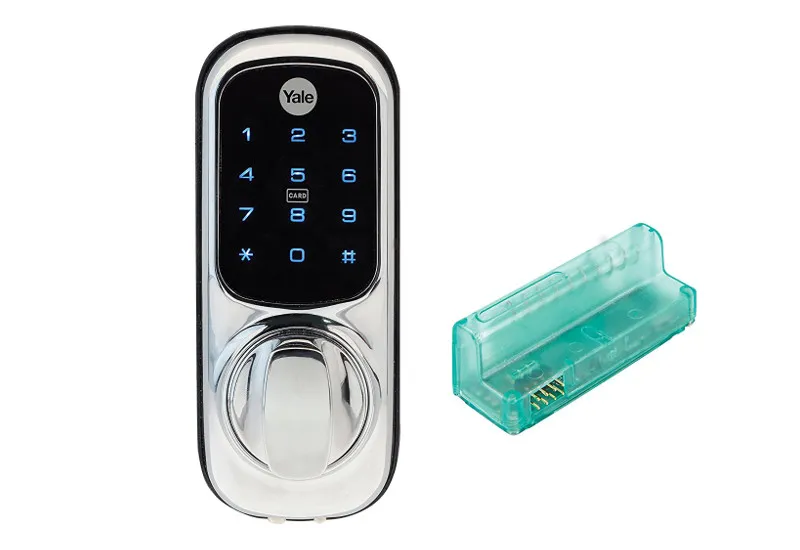
What fits: Yale Keyless Connected Smart Lock. Yale state it is compatible with most 60mm backset nightlatches, and it is also sold bundled with a matching Y3 or PBS1 nightlatch where yours is unsuitable or simply worn out. Entry is by PIN on the touch keypad and by key tag, with an internal thumbturn and a built-in tamper alarm. The lock runs on four AA alkaline batteries, and Yale's current UK manual quotes approximately one year based on the lock being used ten times a day.
What fitting involves: The outside cylinder comes out and the touch keypad mounts through the door on the existing cylinder hole. Yale's fitting instructions call for a 20mm and a 32mm hole prepared from their template, so on a retrofit the existing hole often needs opening out — which is exactly why this route needs care on a certified fire door. Inside, the battery pack and the lock case go on, and the connecting bar is cut to length so it projects the correct amount past the door face; Yale specify 18mm when fitting with the Y3 nightlatch, and on a retrofit it must never be cut shorter than the original tailbar. Yale's instructions also include a handing check before you start: with the door open, put the key in the outside cylinder and turn it 90 degrees each way. If the latch fully withdraws in both directions you are fine. If it withdraws one way only, a supplied handing plate has to go on for the correct direction. There is no external key once the keypad is fitted, so it is worth knowing that Yale's manual also describes an emergency power supply terminal, allowing a 9V battery to power the lock if the cells have completely failed. On its own the lock is a local keypad lock; for app control and remote access it needs the Yale Connect Kit (Yale Access Module plus Wi-Fi bridge), and Yale also list the Keyless Connected among the devices their ConnectX Wi-Fi Bridge works with. We confirm which bridge your configuration needs before the visit.
Timber or hardwood door with a euro-profile mortice lock or euro deadlock and a thumbturn inside — common on converted flats, back doors, side returns and garden or annexe doors
How to tell: The lock is buried in the edge of the door, and the keyhole through the door face is the euro shape — a circle with a slot beneath it. On the inside there is a thumbturn rather than a second keyhole. There is no lift-to-lock action: you simply turn the key or the thumbturn and the deadbolt shoots out.
What fits: Yale Linus Smart Lock L2, mounted over the internal thumbturn, subject to Yale's compatibility checker and to the cylinder protruding at least 3mm from the inside face. We do not offer the Linus Smart Lock L2 Lite on this door type: Yale's UK product page for the Lite states "Compatible with Lift-to-Lock doors only", and a door like this is not a lift-to-lock door. Yale's wider support material is looser about euro cylinders in general, but a support-page generality does not override a live product-page restriction, so until Yale UK say otherwise in writing we take the published bullet at face value rather than talking you past it. Where the existing cylinder is the wrong length or has no thumbturn, the Yale Linus adjustable cylinder or a Yale Platinum 3 Star thumbturn cylinder is the usual answer.
What fitting involves: The same inside-only retrofit as the multipoint case: mounting cradle around the cylinder, the Linus body hooked on and locked with the yellow switch in the battery compartment, thumbturn adapter, DoorSense magnet on the frame. Where the cylinder has to change, we measure both halves separately from the central fixing screw — the internal and external dimensions are usually different — and fit a correct-length 3-star anti-snap replacement, rather than an over-length one that gives a burglar something to grip and snap. The lock case, keeps, hinges and the door itself are untouched. One siting rule: Yale are explicit that the Linus is for interior-side use only and is not intended for outdoor use, so a garden or annexe door whose inside face is effectively outdoors — an open porch, an unheated outbuilding, an exposed side return — is not a suitable position for the unit, however well the cylinder checks out.
Flat entrance door in a block, or any door secured by a BS3621 five-lever mortice lock — very common across London conversions and mansion blocks
How to tell: Two locks on one door: a rim nightlatch higher up and, lower down, a second keyhole that is a tall narrow slot rather than a euro shape, taking a long flat key with cut teeth. That lower lock is a five-lever mortice. Check the faceplate in the edge of the door for a BS kitemark and the number BS3621 — that is the lock your home insurer is usually asking about. Flat entrance doors in blocks are also normally certified fire doors, FD30 or FD30S, with intumescent and smoke seals set into the edge and often a label on the top edge or hinge side.
What fits: There is no current Yale smart lock that replaces a five-lever mortice lock, and we will not pretend otherwise. Where the door also has a 60mm backset rim nightlatch, the practical answer is the Yale Keyless Connected Smart Lock on the nightlatch, leaving the BS3621 mortice completely alone as your insurance-rated deadlock. Where the flat door instead has a euro cylinder with an internal thumbturn, the Yale Linus Smart Lock L2 is the inside-only option that changes nothing at all about the door. We do not specify the Linus L2 Lite here either, for the same published reason as the door type above.
What fitting involves: On the nightlatch route, the work is confined to the existing nightlatch position and the existing cylinder hole — though that hole usually needs opening out to Yale's template, and that is a modification. On the Linus route, nothing is drilled at all. On a certified fire door the distinction matters enormously: any new hole, or a change to a component of a certified doorset, can put the fire certification in question. We will not cut new holes in a certified flat entrance door. If the only way to fit the lock you want is to modify that door, we will tell you from the photos rather than on the day. Freeholder or managing agent consent is a separate question, dealt with below, and on a communal entrance door it is not optional.
What the job actually involves
- The door has to be working properly before any smart lock goes on it, and Yale say so themselves. Their Conexis L2 manual asks you, before you start, to open the door, lift the handle and check the key turns easily, then close the door, lift the handle and check it locks easily — and states that if it does not, the door may be misaligned and needs adjusting first, possibly by a locksmith. A motor is weaker than your wrist. Any door you have been shouldering, lifting or leaning on to lock will defeat a smart lock within weeks. If we find that on the day, adjusting the door comes first.
- The Conexis L2 removes your euro cylinder completely and puts a Yale actuator in its place, so there is no keyhole on the outside afterwards at all. For most customers that is the whole point; for some it is a dealbreaker, particularly households with someone who will not carry a phone. Yale's answer to a flat battery is backup 9V contacts on the outside of the handle. We always fit key tags and set up a second household member on the app before we leave, and we talk this through with you before you commit to the model.
- Two Conexis L2 measurements decide the job and neither can be worked around on the day: the distance between the centre of the cylinder and the centre of the handle spindle must be 92mm, and the door thickness must fall within 44 to 70mm. Yale's 2024 L2 manual supplies fixing packs for 44 to 50mm, 58 to 65mm and 70mm. There are apparent gaps between those bands, and we treat any door that measures into a gap as a check-first case rather than assuming either way. Yale's older Conexis L1 compatibility guide adds a check that the existing screw holes line up with marked zones; we use that as a sanity check on your photos, not as a published L2 rule.
- The Avantis exclusion is real but it is published for the L1. Yale's Conexis L1 compatibility guide states that the L1 is not compatible with the Avantis brand of multipoint door locks, and gives a genuinely visible way to spot one: Avantis multipoint locks have the locking bolt ABOVE the latch bolt on the door edge. Yale's Conexis L2 manual makes no mention of Avantis, so we treat an Avantis door as a stop-and-confirm-with-Yale case rather than telling you it is definitely excluded from the L2.
- For the Linus locks the decisive detail is the inside of your cylinder, not the outside of your door. Yale specify a euro cylinder protruding at least 3mm from the inside face. Where the cylinder is flush or sits behind a backplate handle, the fix is either Yale's adhesive-mount method, one of their dedicated escutcheon or backplate kits, or a cylinder change. When we change a cylinder we measure both halves separately from the central screw and fit a correct-length 3-star anti-snap replacement, rather than an over-length one that gives a burglar something to grip.
- On a lift-to-lock multipoint door, no inside-only lock can lift your handle for you. Yale's own guidance is explicit that where you lift the handle before locking, the auto-lock function is not available on the Linus, because it cannot know whether the handle has been lifted. Everything else works normally. We would rather you understood that before booking than discovered it on day three.
- Yale publish the split-spindle and auto-engage exclusions for the Linus Smart Lock L2 Lite specifically. We have not found Yale extending the same wording to the full Linus L2, so we do not extend it either — but we still check for both on your photos and video, because a split spindle or an auto-engage mechanism changes the shape of the job regardless of which model is on the table.
- The Yale Keyless Connected has a handing check that decides whether an extra plate is needed. Yale's instructions ask you, with the door open, to turn the key in the outside cylinder 90 degrees each way and see whether the latch fully withdraws in both directions. Both directions is straightforward. One direction only means a handing plate has to be fitted the correct way round. We ask for a short video of exactly this before we book a nightlatch job.
- Where remote access is part of what you are buying, the network is part of the job. Yale describe the Linus L2 as having in-built Wi-Fi and Bluetooth, so it does remote access on its own. The L2 Lite does not have Wi-Fi and needs either the Yale ConnectX Wi-Fi Bridge — Yale state it requires a power socket within 10 metres of the smart device and connects up to four devices — or a Thread border router already in the home. The Conexis L2 uses the Yale Access Module with the Yale Connect Wi-Fi Bridge. In a London flat with the router at the back and the front door at the front, a thick Victorian wall between them decides whether remote unlocking actually works, so we check signal at the door before we finish rather than after.
- Battery arrangements differ by model and it is worth knowing which one you are choosing. The Linus L2 uses a rechargeable lithium-ion pack topped up over USB-C, quoted by Yale at up to 6 months. The L2 Lite takes three CR123A cells, also quoted at up to 6 months. The Keyless Connected takes four AA alkalines, with Yale's manual quoting approximately one year at ten uses a day, and has an emergency power terminal so a 9V battery can power it if the cells have completely failed. The Conexis L2 takes four AA alkalines and has the external 9V backup contacts; Yale publish no battery life figure for it, so we do not quote one.
- The older Yale Conexis L1 and the first-generation Yale Linus have both been superseded by the L2 generation in Yale's current UK range. We do not fit them new. If you already have one, that is a different conversation and we can usually keep it running.
What can stop a fit going ahead
We check these from your photos before booking, so a visit is not wasted:
- An auto-engage or auto-locking multipoint mechanism — the type that throws its hooks by itself when the door shuts, with no handle lift. Yale explicitly rule this out for the Linus L2 Lite, and it is the single most common reason a lock chosen from a photo of the outside of the door turns out to be the wrong lock.
- A split-spindle multipoint lock, where the outside handle is dead until the key is turned. Yale state the Linus L2 Lite is not compatible with split spindles. You can usually spot it because the outside handle flops uselessly until you use the key.
- A non-lift-to-lock door where someone has specified a Linus L2 Lite. Yale's UK page for the Lite says "Compatible with Lift-to-Lock doors only". On a single-point timber euro door we will move you to the full Linus L2 rather than fit against the manufacturer's published restriction.
- Handle-to-cylinder centres that are not 92mm, or a door outside the 44 to 70mm thickness range, on a Conexis L2 job. Both are critical measurements and neither can be worked around on the day. Older or bespoke doors, and some aluminium shopfront-style doors, frequently miss on one or both.
- A cylinder with no internal thumbturn, or one sitting flush or recessed rather than proud by at least 3mm, on a job specified around a Linus. This does not stop the work, but it turns a retrofit into a retrofit plus a cylinder change, and if we have not been told in advance we may not have the correct-length cylinder on the van.
- A door that does not lock cleanly by hand. Dropped hinges, a swollen timber door in a wet spell, a uPVC door that has settled so the hooks catch the keeps, or a door you have to lift and shove. Yale's own pre-installation checks are about exactly this. The door gets adjusted first, or the lock gets fitted onto a fault.
- A five-lever BS3621 mortice lock as the only lock on the door. No current Yale smart lock replaces one. If there is no nightlatch and no euro cylinder to work with, there is no same-visit smart lock answer, and we will say so from the photos.
- A certified fire door on a flat entrance in a block. Cutting new holes in an FD30 or FD30S doorset can put its certification in question and we will not do it. Where the existing hardware position can be reused without modifying the doorset, the job can usually still go ahead.
- No freeholder, managing agent or landlord consent where the lease or tenancy requires it, and no permission from the block for anything touching a communal entrance door. A paperwork blocker rather than a technical one, but it stops the visit just as firmly.
- An exposed inside face on the door where a Linus would go. Yale state the Linus is for interior-side use only and not intended for outdoor use, which rules out open porches, unheated outbuildings and similar positions.
- No mains socket within about 10 metres of the door where a Wi-Fi bridge is needed, or no usable Wi-Fi signal at the front door. The lock will fit and work locally; the remote access you were buying will not.
Smart locks in London homes
London's door stock splits almost perfectly down the middle, and that split decides the whole job. On one side are the Victorian, Edwardian and 1930s timber front doors that fill the terraced streets of Hackney, Walthamstow, Peckham, Ealing and Tooting: surface-mounted rim nightlatches, often with a five-lever mortice underneath, and frequently in a conservation area where the outside appearance is not ours to change. That is Keyless Connected country, and only where the nightlatch is a 60mm backset and the door will take the keypad without a modification we should not be making. On the other side are the uPVC and composite lift-to-lock multipoint doors on newer builds, converted flats, side returns and back doors, which are exactly what the Conexis L2 was designed around. The Linus L2 covers ground on both sides wherever there is a euro cylinder with a thumbturn standing proud on the inside, because it fits on the inside only and leaves the street-facing side of the door completely untouched. The Linus L2 Lite belongs to the lift-to-lock half specifically, because that is what Yale publish it for. The leasehold question is the one that most often delays a London job. Most leases treat changing your flat entrance door or its hardware as an alteration needing the freeholder's or managing agent's written consent, and flat entrance doors in blocks are normally certified FD30 or FD30S fire doors, where changing a component of the certified doorset can put its fire certification in question. We will not cut new holes in a certified flat entrance door. In practice that pushes a lot of flat jobs towards the Linus route, which drills nothing and can usually be presented to an agent as a reversible internal fitting rather than an alteration to the door itself. Communal entrance doors are a different animal again: they belong to the block, not to you, and nothing goes on one without the freeholder or management company agreeing in writing. Tenants need their landlord's consent, and should make sure the landlord keeps a way in. There is a London wrinkle on the technology side too. Thick solid walls, long narrow hallways and routers parked in a back bedroom mean the front door is often the worst-covered spot in the property. The Linus L2 has Wi-Fi built in; the L2 Lite needs a ConnectX bridge on a socket within 10 metres or a Thread border router already in the home; the Conexis L2 works through the Yale Access Module and Connect Wi-Fi Bridge. Whichever it is, signal at the door is something we check on site rather than assume. TaskMan of London is a first-party London team — DBS-checked, insured, with a 12-month workmanship warranty on our work — covering London within the M25. Because we quote from your photos over WhatsApp before booking, we can tell you which of those categories your door falls into, and whether the answer is a straightforward fit, a cylinder change first, or a consent conversation with your managing agent, without anyone losing a morning to a visit that was never going to go ahead.
Before you book
- Send a photo of the WHOLE door from the inside, taken far enough back to show the handle, the keyhole and the frame together.
- Send a photo of the WHOLE door from the outside, showing the handle, the keyhole or keypad position, and the door edge.
- Send a close-up of the inside of the lock: the thumbturn or second keyhole, and how far it stands out from the handle plate. Rest a coin or a ruler flat against the plate in the shot so we can judge the 3mm.
- Open the door and photograph the EDGE of the door — the faceplate carrying the latch and any hooks, rollers or cams — including any kitemark or lock brand stamped on it. This one photo answers more questions than any other.
- Measure the thickness of the door with a tape at the edge and tell us the number in millimetres.
- On a multipoint door, measure the distance from the centre of the keyhole to the centre of the handle spindle and tell us the number. 92mm is the figure that matters.
- On a nightlatch door, measure from the edge of the door to the centre of the outside keyhole. 60mm is the figure that matters.
- Send a short video of you locking the door as you normally do. Do you lift the handle then turn the key? Does it lock itself when it shuts? Does the outside handle work before you turn the key? Ten seconds of video settles all three questions.
- On a nightlatch, do Yale's handing check on video: door open, key in the outside cylinder, turn 90 degrees one way and then the other, showing whether the latch pulls fully back both times.
- Tell us the make and model on the lock faceplate or cylinder if anything is legible, and whether the door is a certified fire door — look for intumescent or smoke seals set into the edge, and any label on the top edge or hinge side.
- Tell us how you want to get in day to day: phone only, PIN keypad, key tags for children or a cleaner, or keeping your existing key as well. That choice changes which model we recommend more than the door does in some cases.
- Tell us which phones the household actually uses. Yale document Yale Dot working differently on iPhone and Android, and some Yale Dot multipacks are sold specifically for Android phones, so it is worth settling before we build the access plan.
- If you are a leaseholder or a tenant, or the door is a communal entrance, check what consent you need and start that conversation early. It is the slowest part of the job, not the fitting.
- Tell us where your router sits relative to the front door, and whether there is a spare mains socket near the door.
Yale Smart Lock Installation in London — FAQs
Which Yale smart lock do I need?
It depends on your door, not on which lock you liked the look of. If you lift the handle to lock a uPVC or composite door and you are happy to give up the outside keyhole, the Conexis L2 replaces both handles and the cylinder. If you want the outside of the door to look exactly as it does now and to keep using your key, the Linus L2 fits on the inside only over your existing thumbturn. The smaller Linus L2 Lite is an option too, but only on a lift-to-lock door: Yale's UK page for the Lite states "Compatible with Lift-to-Lock doors only", so we do not put it on a timber door with a euro deadlock, however much neater it looks. If you have a traditional timber front door with a rim nightlatch, the Keyless Connected replaces the outside cylinder with a touch keypad. Send us photos of the door on WhatsApp and we will tell you which one it is before you buy anything.
Will I still be able to use my key?
With the Linus L2 and L2 Lite, yes — nothing changes on the outside of the door and your key works exactly as before. With the Keyless Connected, the outside cylinder is replaced by the keypad, so entry is by PIN or key tag. With the Conexis L2, no: the euro cylinder is removed and replaced by Yale's actuator, so there is no external keyhole at all afterwards. That is a deliberate design choice on Yale's part, and it is the single thing we most want you to be clear about before booking one.
What happens if the batteries die while I am out?
You do not get locked out, but the answer differs by model. Yale build low-battery warnings into the Yale Home app well before the lock stops. On the Conexis L2, which has no external keyhole, Yale provide backup 9V contacts on the outside of the handle so the lock can be powered from outside to let you in. The Keyless Connected also has an emergency power terminal, so a 9V battery can power it if its four AA cells have completely failed — Yale's manual quotes approximately a year of life at ten uses a day. On the Linus locks your ordinary key still opens the door from outside anyway; the L2 uses a rechargeable pack you top up over USB-C and the L2 Lite uses three CR123A cells, both quoted by Yale at up to 6 months.
Can I unlock the door for someone when I am not at home?
Yes, but the model decides what is needed. Yale describe the Linus L2 as having in-built Wi-Fi and Bluetooth, so it does this on its own. The Linus L2 Lite is Bluetooth and Matter over Thread, so it needs the Yale ConnectX Wi-Fi Bridge — Yale state it requires a power socket within 10 metres of the device — or a Thread border router already in the home. The Conexis L2 uses the Yale Access Module with the Yale Connect Wi-Fi Bridge. In an older London property the router is often nowhere near the front door, so checking the signal at the door is part of the job rather than an afterthought.
Can I have a keypad or key fobs as well as the app?
Yes, within what each model supports. The Conexis L2 uses key tags tapped on the outside handle, and Yale's Smart Keypad or Smart Keypad 2 with fingerprint can be added for PIN entry. The Linus L2 works with the Smart Keypad and with Yale Dot, the NFC tap point fitted outside the door — Yale's UK listing for the L2 includes a Yale Dot with the lock, so most L2 customers already have one rather than buying it separately. Yale list the L2 Lite as working with the Smart Keypad, the Fingerprint Keypad and Yale Dot, but state plainly that it does not work with Yale Key Cards or Key Tags. The Keyless Connected has PIN entry on the lock itself plus key tags. One practical note on Yale Dot: Yale document it behaving differently on iPhone and Android, and sell some Dot multipacks specifically for Android phones, so tell us what everyone carries. Then tell us who needs to get in — cleaner, dog walker, teenager, guest — and we will set the access up on the day.
Will fitting a smart lock affect my home insurance?
It can, so it is worth raising with your insurer before we come out. Many UK policies specify a BS3621 five-lever mortice lock or an anti-snap 3-star cylinder on the final exit door. The Conexis L2 holds the BSI IoT Kitemark and Secured by Design accreditation, and where we change a cylinder for a Linus installation we fit a 3-star anti-snap replacement as standard. On a door with a five-lever mortice, our usual recommendation is to leave that lock exactly where it is and put the smart lock on the nightlatch instead, so nothing about your insurance position changes.
I live in a leasehold flat. Do I need permission?
Very possibly, and it is worth checking before you book rather than after. Most leases treat changing your flat entrance door or its hardware as an alteration requiring the freeholder's written consent, and flat entrance doors in blocks are normally certified fire doors, where modifying a component of the certified doorset can affect its certification. Anything on a communal entrance door needs the block's agreement, full stop. The good news is that the Linus L2 fits entirely on the inside without drilling the door, which is usually a far easier conversation with a managing agent than replacing the hardware outright.
How do I get a quote?
Send us a WhatsApp message with photos of your door — inside, outside, and the edge of the door with it open — plus a short video of you locking it as you normally do. We will confirm which Yale model actually fits, whether a cylinder change is needed first, and what the job involves, before anything is booked. If your door is one of the cases where no current Yale lock is a good fit, we will tell you that rather than turn up and find out. TaskMan of London is a first-party team, not a company: the DBS-checked, insured fitter who quotes you is the one who does the work, everything we install carries our 12-month workmanship warranty, and we cover London within the M25.
Book yale smart lock installation in london in London
Send us a photo of your door — the edge showing the lock mechanism, and the inside face — plus the lock you have or are considering. We will confirm compatibility and everything else with you before you book.
WhatsApp us to get started or call 07700 170 070, 7 days a week.
Fitted by TaskMan of London's own DBS-checked, insured team, with a 12-month workmanship warranty.